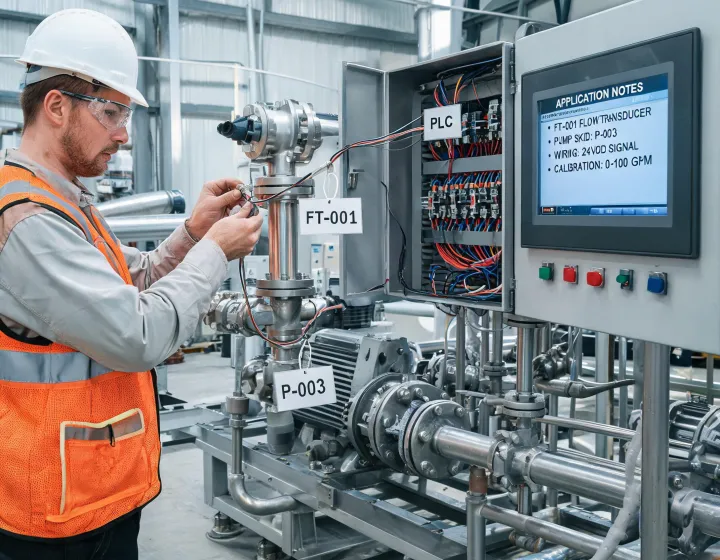
Factory Automation
IO-Link, photoelectric and proximity sensing across packaging lines, conveyor systems and robotic cells. In these environments, the instrument must survive vibration, switching frequency demands, product changeovers, and the need for a clear digital signal that the PLC can diagnose without slowing production. Sick reviews sensor placement, target reflectivity, cable routing, teach behavior, and replacement access before a recommendation is treated as final.
Building & HVAC
Temperature, humidity and IAQ transmitters tied to BMS networks for healthy-building reporting. Building teams need values that can be trended, alarms that do not create unnecessary truck rolls, and devices that maintenance staff can identify during routine inspection. Configuration therefore includes output format, enclosure choice, mounting height, service access, and documentation for the building record.
Logistics & Material Handling
Vision, distance and presence sensors for AS/RS, AGV navigation, and parcel sortation. Logistics applications often expose sensors to dust, changing package surfaces, fast conveyor motion, and compact installation spaces. Sick helps define detection distance, response time, alignment approach, and how each sensor will be verified after mechanical work or seasonal peak changes.
Semiconductor Fab
Cleanroom-rated pressure, particle and gas-flow sensors used in lithography, etch and CMP tools. Fab environments place unusual weight on stability, traceability, and contamination awareness. The discussion includes wetted material compatibility, clean installation handling, signal stability, documented calibration assumptions, and the way device status will be integrated into tool-level records.
Renewable Energy
Wind-turbine pitch encoders, solar-tracking sensors, and grid-tied inverter monitoring transducers. Renewable sites need remote-readiness, environmental tolerance, and a service record that field teams can interpret quickly. Selection focuses on enclosure, cable strain relief, signal reliability, temperature exposure, and evidence that can be understood long after the original commissioning team has moved on.