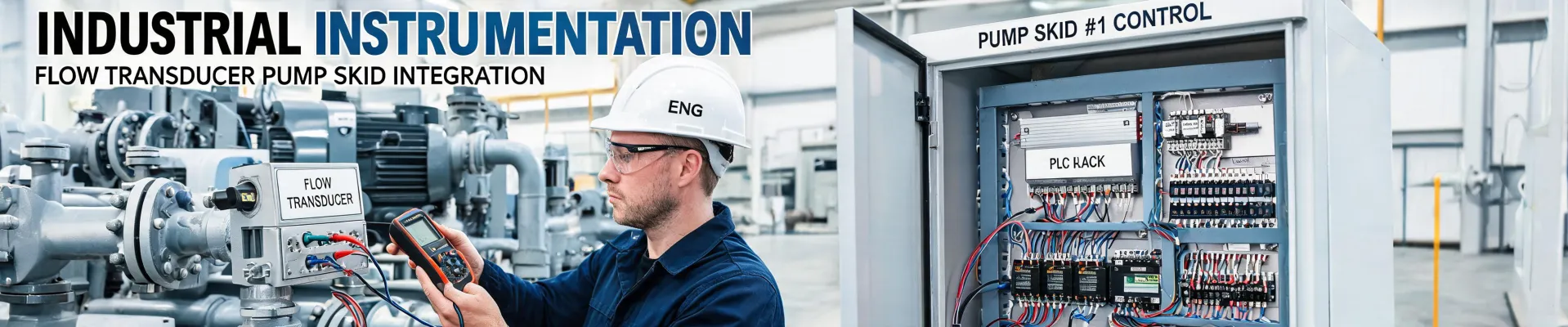
Three questions before 10 a.m.
Monday morning, about 9:40. I get three messages in twenty minutes.
- "Do we have the manual for the Sensus water meter? The installer's asking about register setup and he's standing in the pit."
- "The caliper's dead. What battery do I order?"
- "How much did we pay for the thermal camera? Finance is doing the Q1 review."
None of those are hard questions. All three ate most of my day (ugh).
The meter manual turned out to be a QR code on a card that led to a customer portal we'd never registered for. The caliper battery — I ordered the wrong one first, because there are two button cells that look identical and behave very differently. And the thermal camera price? That invoice was in an email archive from a person who left the company in 2023.
I've been doing purchasing for a company of about 180 people since 2020. I manage roughly $340K a year across a dozen vendors, and I report to both operations and finance, which means I get to hear about the same failure from two directions. What that Monday taught me is a rule I now apply to every order: the invoice is the least informative document in any instrument purchase.
It tells you what you paid. It tells you almost nothing about what you bought.
The problem isn't the manual. It's that nobody bought the manual.
Here's what I used to think the problem was: our filing was sloppy. Fix the filing, fix the problem. I spent a week in 2022 building a shared drive with folders for every asset tag. Beautiful folder structure. Almost empty.
The real issue is upstream of filing. When we buy an instrument, we buy the object. We don't buy the information package that makes the object usable, and we don't buy the consumables plan, and we don't buy the calibration path. Then eighteen months later somebody's standing in a meter pit asking me for a document that technically exists somewhere in the world.
What actually ships in the box
Usually less than people assume. A quick-start card, a safety sheet in four languages, a declaration of conformity, and a URL. That's it for a lot of modern equipment. Full documentation lives behind a portal login, or in a PDF the sales rep emails once and nobody saves.
Take a water meter. The Sensus iPERL manual is a genuinely useful document — installation orientation, flow direction, wiring, register and reading configuration, troubleshooting codes. But if the installation crew is on site and the manual is in a portal nobody has credentials for, the manual may as well not exist. I've watched a two-hour job turn into a two-day job over a configuration step that was documented on page 14.
I assumed for a long time that "the manual" was one thing. It isn't. For most instruments there are at least four separate documents that matter at four different moments: installation, operation, maintenance and consumables, and calibration or verification. The vendor's quick-start card covers the first one, partially, and nothing else.
"Full documentation is available in the customer portal." — the sentence that has cost my department more hours than any price increase I've ever negotiated.
The knowledge lives with one person
This is the part I didn't see for years. In most companies, instrument knowledge isn't in a system. It's in a person. Whoever spec'd the pH meter knows which buffers to use. Whoever ordered the calipers knows the battery spec. Whoever dealt with the water utility knows how the meter endpoints are read.
Then that person changes roles, or retires, or just stops answering Slack messages about batteries because it's not their job anymore. And there's no handover, because nobody ever treated that knowledge as an asset in the first place.
I'll be honest about my limits here: I'm not a metrologist and I'm not an instrument technician, so I can't speak to measurement uncertainty or calibration intervals for any specific device. What I can tell you from a procurement seat is that the cost of lost knowledge shows up on my budget line, and it shows up late, and it shows up as something else — a reorder, a rework, a rejected batch, an expedited shipping charge.
What it actually costs when the documentation isn't there
Four examples from our own records. None of these were dramatic. All of them were avoidable.
The caliper battery (a $12 problem that cost $240)
Digital calipers typically run on button cells — SR44 or LR44, sometimes sold as 357 or A76. They're the same size and they are not the same battery. SR44 is silver oxide, holds a steadier voltage, and lasts longer. LR44 is alkaline and cheaper, and in my experience it's the one that leaks when a caliper sits in a drawer for eight months.
We learned that the expensive way. A caliper came out of storage with corrosion across the battery contacts. Not repairable at our level. I replaced a $200 instrument because I saved about $4 on a coin cell (note to self: put the spec on the asset tag, not in a spreadsheet nobody opens).
The pH meter (the one that scared me)
We have a Mettler Toledo pH meter in our water lab. Standard gear, well documented, and the documentation is exactly what makes it work — buffer solutions for calibration, electrode storage in the right solution, rinse procedure between samples. Skip those and the readings drift and nobody notices for a while, because the number on the screen looks perfectly reasonable.
Anybody searching "how to use a Mettler Toledo pH meter" is usually not looking for theory. They're looking for the SOP: which buffers, what order, how often, what to do with the electrode overnight. If that lives in one technician's head, you're one resignation away from data you can't defend. That's the version of this problem that involves auditors, and it's the one I lose sleep over.
The water meter manual (the one that involves other people's money)
Water metering is the category where this bites hardest, because the meter is the billing instrument. When an installation is configured wrong — flow direction, orientation, pulse factor, endpoint pairing — the error doesn't announce itself. It shows up months later as a consumption discrepancy, and then you're reconstructing what was installed and how, from memory.
That's why I now insist the Sensus water meter manual for whatever series we're installing — iPERL, OMNI, whichever — gets filed at commissioning, not at purchase. Same document, different moment. Filed at purchase, it's a PDF in a folder. Filed at commissioning, with the actual configuration values written down next to it, it's an asset.
The thermal camera (why "cheapest" is a moving target)
We needed a thermal camera for panel inspections. The request that reached me said "thermal camera" and a number. No resolution spec, no temperature range, no emissivity requirement, no idea whether we needed radiometric output or just a pretty picture.
Publicly listed pricing as of early 2025, for reference — and please verify current rates, this market moves: basic handheld units run somewhere in the $300–$1,000 band, mid-range inspection cameras with decent resolution and radiometric capture roughly $1,000–$3,500, and higher-end models well past that. Take those ranges with a grain of salt; they shift with sensor supply and model refreshes.
We bought near the bottom of the range. It didn't have the resolution to spot what our electrician needed to spot. Six months later we bought again, in the middle of the range. The $600 we "saved" on the first unit is the most expensive $600 I've spent in this job.
What I changed in our purchase orders
I'm not going to pretend this is a sophisticated system. It's a paragraph in the PO and a five-line checklist, and it's saved us more than any negotiation I've run.
The paragraph: supplier to provide full operation, maintenance and calibration documentation in PDF, plus a printed quick reference, plus written specification of all consumables (battery type, electrodes, buffers, filters), plus a named technical support contact. If a vendor can't meet it, that's information I want before I place the order, not after.
The checklist, applied at commissioning rather than at purchase:
- Manual filed and linked to the asset tag
- Consumables spec written on the asset label itself
- Calibration certificate filed with the serial number
- Support contact recorded somewhere the next person will look
- One named owner for the asset, with a name in the record
That's it. It costs about twenty minutes per instrument. Compare it to the day I lost in January, and it isn't close.
The habit I've had to unlearn is judging a purchase by its unit price. The number on the quote is the smallest number in the whole transaction — the manual, the battery, the calibration, the second purchase, those are the ones that decide whether you got a good deal. Most of the equipment failures I've dealt with weren't equipment failures. They were handover failures that took a year to surface.
Next time someone asks you where the manual is, the honest answer might be that nobody ever bought it. That's a fixable problem, and it's a lot cheaper to fix on the PO than in a meter pit.